
Choosing a basketball coaching board is easier when you start with the way you coach. For quick explanations on the bench, look for a format you can hold comfortably and draw on without squeezing the diagram. If you prefer to move players through a sequence, consider a magnetic board with enough space for the positions you need to show.
Size, surface and court layout work together. The right combination should fit the situation, your bag and the amount of detail your players need to see.
Start with where you will use the board
Picture a normal week. Will the board travel between several sports halls? Will you mainly use it during timeouts, stop a drill to explain a movement, or prepare a longer discussion in the changing room?
Those situations place different demands on the same piece of equipment. A board for quick courtside explanations needs to be convenient to pick up, hold and put down. A board used for longer discussions may benefit from more drawing space, particularly when you want to keep several positions visible.
Write down your main use before comparing models. It gives you a practical reason for choosing one format over another.
Choose a size that gives your drawings room
A useful size test is to draw one play you explain regularly. Include the starting positions, the first pass and the main movement. Then ask whether you have left enough space to follow the sequence without adding tiny arrows between crowded markings.
Also consider the people viewing it. Check the diagram from the position a player would occupy, rather than only looking straight down at the board yourself. The angle at which you hold it matters alongside its dimensions.
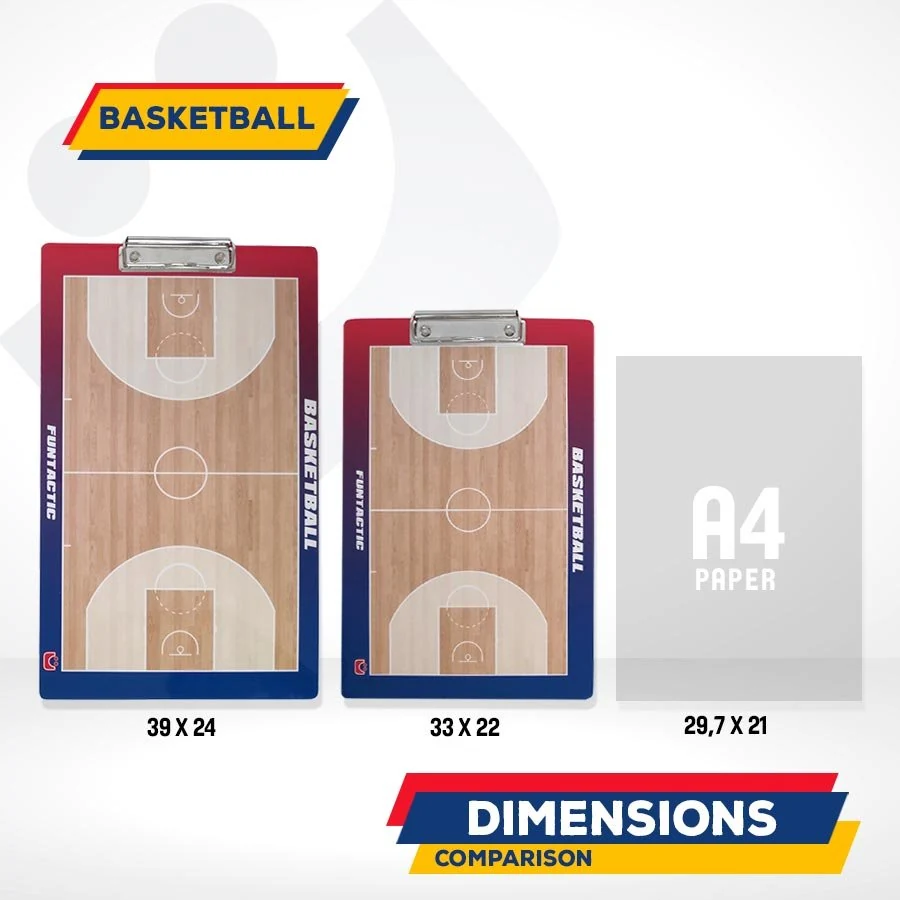
Our basketball coaching board is available in 33 × 22 cm and 39 × 24 cm formats. Both include a clip for papers.
Use the smaller format as your starting point if compactness is a priority. Consider the larger format if your usual diagrams need more room. Before deciding, check the space inside your coaching bag and think about how comfortably you can hold each size while drawing.
Decide how you want to explain movement
With a dry erase board, you draw positions and routes, then change the diagram as the explanation develops. This can suit a coach who prefers to sketch a situation quickly and discuss one movement at a time.
Magnets offer another way to work. You can leave the starting positions in place, move one player and discuss what changes elsewhere. That makes a magnetic model worth considering if you regularly walk through positioning or ask players to move the pieces themselves.
Magnetic and dry erase are compatible features: a board may support both. Check the individual product description for the available writing and magnetic surfaces.
The FunTactic magnetic basketball coaching board measures 45 × 30 cm and includes a set of magnets.

Choose according to the explanation you want to give. If you rarely use magnets, they do not need to decide your purchase. If moving positions is central to your teaching, allow enough space for the pieces and the drawing around them.
Check what is printed on both sides
The court layout determines how you use the available drawing area.
A full-court view gives you room to show a situation that involves both ends: an inbound pass, progress up the floor and the next attacking position. A half-court view lets you concentrate on a smaller area when explaining an offensive entry, screening action or defensive adjustment.
Our standard basketball board has a full court on the front and a half court with a starters’ roster on the reverse.

Look at both sides before ordering. Consider whether you will use each section and whether it leaves the space you need for your normal explanations. A roster area is useful when you intend to keep that information beside the court; its value depends on your own routine.
Keep personalisation clear and purposeful
FunTactic personalisation includes colours, a club logo, the club name and the coach’s name.
When choosing a design, consider the drawing area first. A large crest or a busy background may compete with the marks you want players to follow. Ask yourself where the ball and players will be drawn, and whether those positions remain easy to distinguish from the printed design.
Treat colour as a practical choice as well as part of your club identity. Compare the proposed court colour with the marker colour you intend to use. Keep names and additional wording short enough to read without taking over the board.
Check the details you will handle every day
Look beyond the main product photograph. Examine the corners, edges, writing area and any clip or holder. If you normally attach a practice plan or match notes, consider where those papers sit and whether they interfere with drawing or turning the board over.
Check what is included with the option you select. Marker and eraser options are available for the standard board.
If you are comparing surfaces in person, use a compatible marker to draw and erase a short sequence. If buying online, look for clear photographs or ask for a demonstration of the model that interests you. A specific answer is more useful than guessing from a general description.
Make the final choice with a short checklist
Before ordering, confirm these five points:
- Use: Where will I use the board most often?
- Size: Is there room for my normal diagrams, and does it fit my bag?
- Surface: Do I want to draw, move magnets, or do both?
- Layout: Will I use the printed areas on each side?
- Design: Are the court, markings and personalisation easy to distinguish?
These answers give you a clear brief for your board. Explore the FunTactic basketball coaching board, or contact us with the format, colours and layout you have in mind. If you are choosing between models, tell us how you plan to use yours so we can help you compare the relevant options.
 EN
 SR
